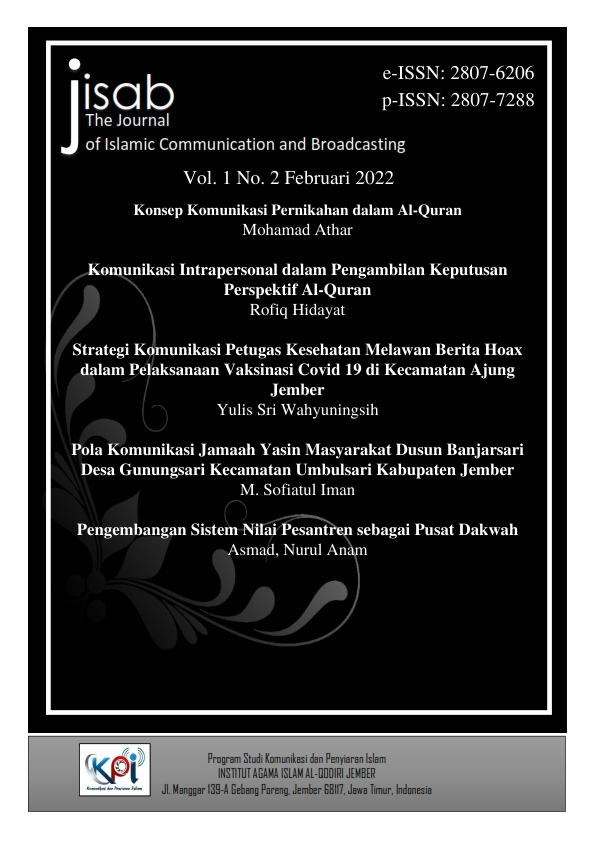
About the Journal

JISAB: The Journal of Islamic Communication and Broadcasting aims to encourage scholarly discussions and research on the development of Islamic communication, Islamic broadcasting, da’wah media, communication technology, and the dynamics of communication culture within Muslim societies. This journal welcomes articles that employ critical approaches to communication, broadcasting, Islamic da’wah, digital media, and technological transformation from Islamic perspectives, particularly through the approaches of communication studies, Islamic studies, social sciences, humanities, and cultural studies.

This journal primarily focuses on the development of studies in Islamic communication and broadcasting, including da’wah strategies, interpersonal communication in Muslim communities, group communication, Islamic mass communication, da’wah media production, Islamic digital literacy, and the relationship between media, religion, and society. The journal views communication not merely as a process of message transmission, but also as a process of constructing understanding, encouraging social transformation, and strengthening Islamic values within social life.

JISAB: The Journal of Islamic Communication and Broadcasting is not a journal that focuses solely on the technical aspects of broadcasting practices or the use of media as a communication tool. The journal does not aim to publish studies that only describe the use of media technology without deeper social, cultural, and religious analysis, nor does it prioritize practical guidelines for producing da’wah content without strong academic foundations.

Instead, the journal invites submissions that engage with contemporary debates in Islamic communication and broadcasting, including:

  1. How Islamic communication adapts to the development of digital media and changing communication cultures within society.
  2. The transformation of Islamic da’wah strategies and broadcasting practices in response to advances in communication technology.
  3. The role of digital media in the production, distribution, and consumption of Islamic messages.
  4. How Islamic media contributes to the formation of religious understanding, Muslim identity, and religious practices in society.
  5. The relationship between Islamic communication and social issues such as religious moderation, tolerance, social justice, and community empowerment.
  6. The role of interpersonal communication and group communication in building social relationships based on Islamic values.

JISAB: The Journal of Islamic Communication and Broadcasting examines these issues through a multidisciplinary perspective by presenting high-quality research contributions from communication studies, broadcasting, da’wah studies, Islamic studies, sociology of religion, communication psychology, media studies, and information technology development.

The editors encourage critical, contextual, and comparative studies using various research paradigms and methodologies, including qualitative, quantitative, and mixed-method approaches. The journal welcomes various types of submissions, including empirical research articles, conceptual studies, literature reviews, media analysis, policy studies, and research on contemporary developments in Islamic communication.